MANITOBA HOME-BUYING TOOL

Manitoba Land Transfer Tax Calculator

Estimate Manitoba land transfer tax using the property's purchase price or fair market value when the transfer is registered.

Progressive Manitoba tax ratesRegistration fees and other closing costs are not included

Property information

What is not included?

This estimate excludes Land Titles registration fees, legal fees, title insurance, property-tax adjustments, mortgage costs and other closing expenses.

ESTIMATED TAX

Your land transfer tax

Estimate
Estimated Manitoba land transfer tax$0.00Effective tax rate: 0.00%
Property value$0.00
Property value plus tax$0.00

Progressive tax breakdown

First $30,000 at 0%$0.00
$30,001–$90,000 at 0.5%$0.00
$90,001–$150,000 at 1.0%$0.00
$150,001–$200,000 at 1.5%$0.00
Amount over $200,000 at 2.0%$0.00
Total estimated tax$0.00
First bracket0%First $30,000
Middle brackets0.5%–1.5%From $30,001 to $200,000
Top bracket2%Amount above $200,000
Manitoba Land Transfer Tax Calculator 2026

Canada Child Benefit Calculator 2026–2027

Use the Canada Child Benefit Calculator above to estimate how much tax-free CCB your family could receive each month and year.

The calculator uses the Canada Child Benefit amounts and income thresholds for the July 2026 to June 2027 benefit period. Your estimated payment is based on:

  • Your 2025 adjusted family net income

  • The number of eligible children in your household

  • The ages of your children

  • Whether shared custody applies

The result is an estimate only. Your official Canada Child Benefit payment is calculated by the Canada Revenue Agency using the information in your tax returns and benefit account.

What Is the Canada Child Benefit?

The Canada Child Benefit, commonly called the CCB, is a tax-free monthly payment provided to eligible families to help with the cost of raising children under 18.

The amount a family receives depends mainly on its adjusted family net income, the number of eligible children and each child’s age.

Unlike taxable employment income, regular CCB payments generally do not need to be included as taxable income on your tax return.

You can learn more about the program through the official Canada Revenue Agency CCB information page.

Maximum Canada Child Benefit Amounts for 2026–2027

For the payment period from July 2026 to June 2027, the maximum Canada Child Benefit amounts are:

Child’s ageMaximum annual CCBMaximum monthly CCB
Under 6$8,157$679.75
Age 6 to 17$6,883Approximately $573.58

These maximum amounts generally apply when a family’s adjusted family net income is $38,237 or less.

Once family income rises above this amount, the benefit starts to decrease. A higher income does not always mean that the entire benefit disappears immediately. Instead, the payment is gradually reduced according to the number of children in the family.

The CRA publishes the current payment amounts and reduction formulas on its Canada Child Benefit amount page.

How to Use the Canada Child Benefit Calculator

The calculator is designed to provide a quick estimate without requiring registration or personal identification.

1. Enter your adjusted family net income

Enter your family’s adjusted net income for the 2025 tax year.

For a couple, family income usually includes the relevant net income of both spouses or common-law partners. The CRA may also make certain adjustments when determining adjusted family net income.

Do not enter only one partner’s income when both partners are required to file tax returns.

2. Enter the number of children under six

Select how many eligible children will be under six during the relevant payment period.

Each eligible child under six may qualify for a maximum annual benefit of $8,157 before the income-based reduction.

3. Enter the number of children aged 6 to 17

Select the number of eligible children between six and 17 years old.

Each eligible child in this age group may qualify for a maximum annual benefit of $6,883 before the income-based reduction.

4. Select shared custody when applicable

Select the shared-custody option when both parents share custody of the entered children.

Under CRA rules, each eligible shared-custody parent generally receives 50% of the amount they would have received if the child lived with them full time.

Shared-custody arrangements can be more complicated when they apply to only some children. In that situation, use the calculator as a general estimate and confirm the amount through your CRA account.

5. Review your results

The calculator displays:

  • Estimated monthly CCB

  • Estimated annual CCB

  • Maximum benefit before reduction

  • Estimated income-based reduction

  • Number of eligible children

  • Income range used

  • Reduction formula applied

Your actual payment may be different because the CRA may consider information that cannot be fully captured by a basic online calculator.

How the CCB Is Calculated

The calculation begins with the maximum benefit for all eligible children.

For example, suppose a family has:

  • One child under six

  • One child aged six to 17

The maximum annual benefit before income reduction would be:

$8,157 + $6,883 = $15,040

The calculator then compares the family’s adjusted family net income with the applicable income thresholds.

Family income of $38,237 or less

A qualifying family with adjusted family net income of $38,237 or less may receive the maximum benefit, subject to eligibility and other CRA rules.

Family income between $38,237 and $82,847

When adjusted family net income is between these two thresholds, the benefit is reduced by:

Number of eligible childrenReduction rate
One child7%
Two children13.5%
Three children19%
Four or more children23%

The percentage is applied to the portion of family income above $38,237.

Family income above $82,847

A second reduction formula applies when adjusted family net income exceeds $82,847.

The calculation includes a fixed reduction for the first income range, followed by an additional percentage of income above the second threshold.

Number of eligible childrenBase reductionAdditional reduction
One child$3,1233.2% above $82,847
Two children$6,0225.7% above $82,847
Three children$8,4768% above $82,847
Four or more children$10,2609.5% above $82,847

These rules allow the benefit to decrease gradually as family income rises.

Canada Child Benefit Calculation Example

Suppose a family has:

  • Two children under six

  • Adjusted family net income of $60,000

  • No shared-custody adjustment

The maximum annual benefit would be:

2 × $8,157 = $16,314

The family has two eligible children, so the applicable reduction rate in the first income range is 13.5%.

Income above the first threshold:

$60,000 − $38,237 = $21,763

Estimated reduction:

$21,763 × 13.5% = approximately $2,938

Estimated annual CCB:

$16,314 − $2,938 = approximately $13,376

Estimated monthly payment:

$13,376 ÷ 12 = approximately $1,114.67

This is an estimate. The CRA’s official calculation may include additional factors.

Which Tax Return Is Used for the 2026–2027 CCB?

The CCB payment period runs from July of one year until June of the following year.

For the July 2026 to June 2027 payment period, the CRA generally uses adjusted family net income from your 2025 tax returns.

This means your July 2026 payment may be different from your June 2026 payment, even when your family situation has not changed. The two payments can be based on different tax years.

Both spouses or common-law partners should file their tax returns every year, even when one person had no income. Failure to file can delay or stop benefit payments.

Estimate your employment income and deductions with the Manitoba Income Tax Guide and Calculator.

Hourly workers can also use our Hourly to Annual Salary Converter before estimating their yearly household income.

Who Is Eligible for the Canada Child Benefit?

You may qualify when you meet the CRA’s eligibility requirements, including all of the following general conditions:

  • You live with a child who is under 18

  • You are primarily responsible for the child’s care and upbringing

  • You are a resident of Canada for tax purposes

  • You or your spouse or common-law partner meet the required Canadian status conditions

The person primarily responsible for the child’s care usually applies for the benefit.

Eligibility can depend on immigration status, residency, custody and family circumstances. Review the CRA’s official CCB eligibility requirements before relying on an estimate.

How to Apply for the Canada Child Benefit

You may be able to apply through:

  • Birth registration in participating provinces and territories

  • CRA My Account

  • Form RC66, Canada Child Benefits Application

Newcomers to Canada may need to provide additional information about residency, immigration status and worldwide income.

The CRA provides application instructions on its official CCB application page.

When Are CCB Payments Issued?

CCB payments are generally issued around the 20th day of each month.

The payment date may be moved when the regular date falls near a weekend or public holiday.

For the remaining months of 2026, the published payment dates include:

  • August 20, 2026

  • September 18, 2026

  • October 20, 2026

  • November 20, 2026

  • December 11, 2026

When the total monthly benefit is less than $20, the CRA may issue one lump-sum payment instead of monthly payments.

Check the latest dates on the CRA benefit payment schedule.

Does Shared Custody Affect the CCB?

Yes. Shared custody can affect how much each parent receives.

The CRA generally considers an arrangement to be shared custody when the child lives with each parent on an approximately equal basis. Each eligible parent normally receives 50% of the amount they would receive if the child lived with them full time.

The payment for each parent is calculated using that parent’s own adjusted family net income and family circumstances. It is not necessarily calculated by simply dividing one parent’s existing payment in half.

The shared-custody option in this calculator provides a simplified estimate and applies the adjustment to all children entered.

What Is the Child Disability Benefit?

The Child Disability Benefit is an additional tax-free amount for families caring for a child under 18 who qualifies for the Disability Tax Credit.

For July 2026 to June 2027, an eligible family may receive up to $3,480 annually, or $290 per month, for each qualifying child.

The CRA generally calculates this amount automatically when the child has been approved for the Disability Tax Credit and the family qualifies for the CCB.

The Child Disability Benefit is not included in the OmniTools calculator’s standard estimate.

Why Your CCB Payment May Change

Your payment may change because of:

  • A change in family income

  • A child turning six

  • A child turning 18

  • Marriage or a new common-law relationship

  • Separation or divorce

  • A change in custody

  • A change in the number of eligible children

  • Updated tax-return information

  • A change in Canadian residency status

Report important family changes to the CRA promptly. Waiting until the next tax return could cause an overpayment or underpayment.

Planning Your Household Budget With the CCB

The CCB can help with regular costs such as food, clothing, school supplies, transportation and child care. However, families should avoid treating a calculator estimate as guaranteed income until the official payment appears in their CRA account.

For a more complete budget, combine the CCB estimate with your employment income, housing expenses and debt payments.

Helpful OmniTools resources include:

Frequently Asked Questions

Is the Canada Child Benefit taxable?

The Canada Child Benefit is generally a tax-free payment and is not normally included as taxable income.

How much is the CCB for a child under six in 2026?

For July 2026 to June 2027, the maximum amount is $8,157 annually, equivalent to $679.75 per month, before income-based reductions.

How much is the CCB for a child aged 6 to 17?

The maximum annual amount is $6,883 for July 2026 to June 2027, or approximately $573.58 per month before income-based reductions.

Which income year is used for July 2026 CCB payments?

The CRA uses adjusted family net income from the 2025 tax year for payments issued from July 2026 through June 2027.

Can higher-income families receive the CCB?

Some higher-income families may still receive a partial benefit. The amount gradually decreases based on adjusted family net income and the number of eligible children.

Do both spouses need to file a tax return?

Yes. Both spouses or common-law partners generally need to file annual tax returns, even when one person had no income, so the CRA can calculate the benefit.

Is the OmniTools CCB Calculator an official CRA calculator?

No. It is an independent educational estimator. Your official amount is determined only by the Canada Revenue Agency.

Final Thoughts

The Canada Child Benefit Calculator 2026–2027 can help you estimate your monthly and annual CCB based on your 2025 adjusted family net income and the ages of your children.

Use the calculator for household planning, but confirm your official payment through CRA My Account. Your actual amount may differ because of custody arrangements, marital status, tax-return adjustments, residency, disability eligibility and other family information.

Last updated: July 2026

Disclaimer: This calculator and guide are provided for general educational purposes only. OmniTools is not affiliated with the Canada Revenue Agency or the Government of Canada. The result is not financial, tax or legal advice.


Free Manitoba Land Transfer Tax Calculator 2026

Buying a home, condominium, vacant land or another property in Manitoba can involve several expenses beyond the purchase price. One of the largest provincial closing costs is Manitoba land transfer tax.

Use the Manitoba Land Transfer Tax Calculator above to estimate the tax payable on a property transfer. Enter the purchase price or fair market value, and the calculator will apply Manitoba’s progressive tax brackets automatically.

The calculator shows:

  • Estimated Manitoba land transfer tax

  • Property value used in the calculation

  • Effective tax rate

  • Tax charged within each bracket

  • Property value plus estimated land transfer tax

This tool provides an estimate only. Land Titles registration fees, legal fees, title insurance and other closing expenses are calculated separately.

How to Use the Manitoba Land Transfer Tax Calculator

The Manitoba Land Transfer Tax Calculator is designed to provide a quick estimate without requiring registration or personal information.

Step 1: Enter the property value

Enter the property’s purchase price or estimated fair market value in the calculator.

Manitoba states that land transfer tax is calculated using the property’s fair market value on the date the transfer is registered. In an ordinary arm’s-length home purchase, the agreed purchase price may be close to the fair market value, but the two values are not necessarily identical in every transaction. (Government of Manitoba)

Step 2: Select a quick value or type your own amount

You can type an exact value or use one of the quick-selection buttons, such as:

  • $250,000

  • $400,000

  • $500,000

  • $750,000

The calculator updates the estimated tax automatically when the property value changes.

Step 3: Review the total estimated tax

The main result displays the estimated Manitoba land transfer tax.

The calculator also shows the effective tax rate. This is the estimated tax divided by the total property value.

Step 4: Review the progressive tax breakdown

The result section explains how much tax applies within each bracket. Manitoba does not apply one tax rate to the entire property value. Each rate applies only to the portion of the property value within that bracket.

Step 5: Add other home-buying expenses

The calculator does not include every cost required to complete a property purchase.

After estimating the tax, use our Manitoba Mortgage Calculator to estimate your mortgage payment, minimum down payment and mortgage insurance.

What Is Manitoba Land Transfer Tax?

Manitoba land transfer tax is generally payable when ownership of land or real property is transferred and registered through the province’s Land Titles system.

The person receiving ownership of the property, commonly the buyer, is generally responsible for the tax, subject to applicable exemptions and transaction-specific rules.

The tax is payable in addition to the applicable Land Titles registration fee. The Manitoba government confirms that land transfer tax and registration charges are separate costs. (Government of Manitoba)

The Manitoba Land Transfer Tax Calculator estimates the provincial tax using the standard progressive brackets published by the Manitoba government.

Manitoba Land Transfer Tax Rates

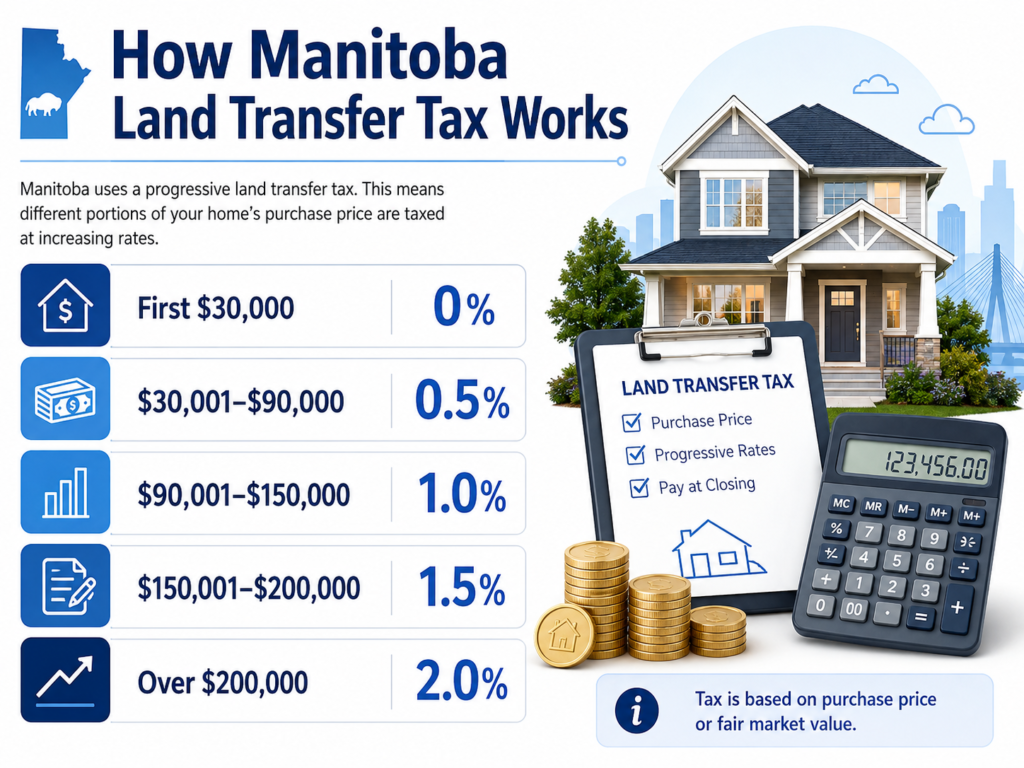
Manitoba currently uses the following progressive rates:

Portion of property valueTax rate
First $30,0000%
$30,001 to $90,0000.5%
$90,001 to $150,0001.0%
$150,001 to $200,0001.5%
Amount above $200,0002.0%

These brackets are published by Manitoba Finance. The tax is based on the fair market value of the property when the transfer is registered. (Government of Manitoba)

How Manitoba Land Transfer Tax Is Calculated

Manitoba uses a marginal or progressive calculation. This means that a property does not become subject to a single higher rate simply because its value enters the next bracket.

For example, when a property is worth more than $200,000:

  • The first $30,000 is taxed at 0%

  • The next $60,000 is taxed at 0.5%

  • The next $60,000 is taxed at 1%

  • The next $50,000 is taxed at 1.5%

  • Only the value above $200,000 is taxed at 2%

The tax accumulated through the first $200,000 is:

$300 + $600 + $750 = $1,650

Therefore, for an ordinary property value above $200,000, the calculation can be simplified as:

Land transfer tax =
$1,650 + 2% of the amount above $200,000

The Manitoba Land Transfer Tax Calculator performs this calculation automatically.
How Manitoba Land Transfer Tax Works

Manitoba Land Transfer Tax Examples

Example 1: Property worth $90,000

The first $30,000 is tax-free.

First $30,000 × 0% = $0
Next $60,000 × 0.5% = $300

Estimated land transfer tax: $300

Example 2: Property worth $150,000

First $30,000 × 0% = $0
Next $60,000 × 0.5% = $300
Next $60,000 × 1% = $600

Estimated land transfer tax: $900

Example 3: Property worth $200,000

First $30,000 × 0% = $0
Next $60,000 × 0.5% = $300
Next $60,000 × 1% = $600
Next $50,000 × 1.5% = $750

Estimated land transfer tax: $1,650

Example 4: Property worth $400,000

Tax on the first $200,000 = $1,650
Amount above $200,000 = $200,000
$200,000 × 2% = $4,000

Estimated land transfer tax: $5,650

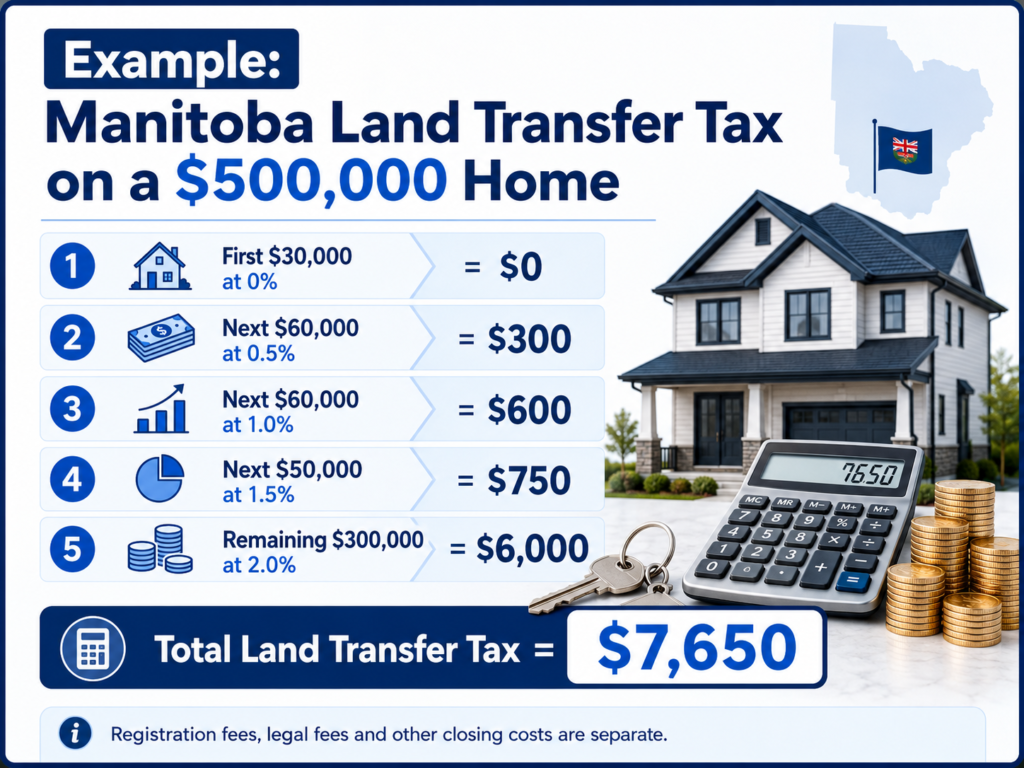
Example 5: Property worth $500,000

First $30,000 at 0% = $0
Next $60,000 at 0.5% = $300
Next $60,000 at 1% = $600
Next $50,000 at 1.5% = $750
Remaining $300,000 at 2% = $6,000
$500,000 Home Example

Estimated land transfer tax: $7,650

Example 6: Property worth $750,000

Tax on the first $200,000 = $1,650
Amount above $200,000 = $550,000
$550,000 × 2% = $11,000

Estimated land transfer tax: $12,650

You can test any property value using the Manitoba Land Transfer Tax Calculator at the top of this page.

Manitoba Land Transfer Tax Table

The following table provides quick estimates for several property values:

Property valueEstimated land transfer tax
$30,000$0
$50,000$100
$90,000$300
$100,000$400
$150,000$900
$175,000$1,275
$200,000$1,650
$250,000$2,650
$300,000$3,650
$400,000$5,650
$500,000$7,650
$600,000$9,650
$750,000$12,650
$1,000,000$17,650

These examples assume the standard Manitoba tax brackets and do not include registration charges or other closing expenses.

Is Land Transfer Tax Based on Purchase Price or Fair Market Value?

The official rule refers to the property’s fair market value on the date of registration, rather than relying exclusively on the amount written in the purchase agreement. (Government of Manitoba)

For many ordinary purchases between unrelated buyers and sellers, the purchase price may reasonably represent the property’s market value. However, additional considerations may arise when:

  • Property is transferred between relatives

  • Ownership is transferred as a gift

  • Only part of an ownership interest is transferred

  • The transaction involves a trust

  • The sale price does not represent market value

  • The transfer may qualify for an exemption

The calculator should be used as a planning tool. A Manitoba real-estate lawyer should determine the final taxable value and filing requirements.

Is There a First-Time Homebuyer Land Transfer Tax Rebate in Manitoba?

Manitoba’s standard published land transfer tax schedule does not currently list a broad provincial rebate that automatically eliminates the tax for every first-time homebuyer.

First-time buyers should therefore include the estimated tax in their initial home-buying budget unless a lawyer confirms that a specific exemption applies to their transaction.

Do not confuse Manitoba land transfer tax with federal homebuyer programs or income-tax credits. These programs may reduce other home-buying costs but do not automatically remove Manitoba’s provincial transfer tax.

Is the Land Titles Registration Fee Included?

No. The Manitoba Land Transfer Tax Calculator estimates land transfer tax only.

Manitoba explains that a transferee may be required to pay both land transfer tax and a registration fee when the transfer is registered. (Government of Manitoba)

Depending on the transaction, additional registrations may also be required, such as registering a mortgage.

Registration charges can change. Confirm the current fee with:

  • Your real-estate lawyer

  • Teranet Manitoba

  • The applicable Manitoba Land Titles Office

Other Closing Costs to Consider

Land transfer tax is only one part of a complete home-buying budget.

Buyers may also need money for:

  • Down payment

  • Mortgage loan insurance

  • Transfer registration

  • Mortgage registration

  • Lawyer’s professional fees

  • Legal disbursements

  • Title insurance

  • Home inspection

  • Property appraisal

  • Property-tax adjustment

  • Utility adjustments

  • Home insurance

  • Moving costs

  • Immediate repairs or renovations

Use the Manitoba Mortgage Calculator to compare mortgage payments, down-payment amounts and financing scenarios.

The mortgage calculator also explains how land transfer tax fits into a broader Manitoba home-buying budget. (omnitools.ca)

When Is Manitoba Land Transfer Tax Paid?

The tax is generally dealt with when the property transfer is registered through Manitoba’s Land Titles system.

In a typical home purchase, the buyer’s lawyer calculates the amount, collects the required funds and handles the registration process as part of closing.

Ask your lawyer for a written statement showing:

  • Purchase funds

  • Land transfer tax

  • Registration charges

  • Legal fees

  • Disbursements

  • Tax adjustments

  • Other closing amounts

The amount produced by an online calculator should not replace your lawyer’s final closing statement.

Can Manitoba Land Transfer Tax Be Added to a Mortgage?

Land transfer tax is generally considered a closing cost rather than part of the property’s purchase price.

Whether a buyer can indirectly borrow funds to cover it depends on the lender, mortgage qualification, available credit and financing structure. Buyers should not assume that the tax will automatically be added to their mortgage balance.

Before making an offer, calculate:

Down payment
+ Land transfer tax
+ Registration expenses
+ Legal and inspection costs
+ Other closing expenses

This provides a more realistic estimate of the cash needed to complete the purchase.

Why Use the Manitoba Land Transfer Tax Calculator?

The Manitoba Land Transfer Tax Calculator can help you:

  • Estimate a major closing cost

  • Compare properties at different prices

  • Plan the cash required at closing

  • Understand Manitoba’s progressive rates

  • Review each part of the calculation

  • Avoid applying 2% to the entire property value incorrectly

Because the calculation is progressive, calculating it manually can lead to errors. The calculator separates the value into the appropriate brackets automatically.

Frequently Asked Questions

Is the Manitoba Land Transfer Tax Calculator free?

Yes. The calculator is free to use and does not require registration.

Does the calculator include legal fees?

No. It estimates provincial land transfer tax only. Legal fees, disbursements, registration fees, title insurance and other costs are separate.

What is the tax on a $300,000 home in Manitoba?

The estimated land transfer tax is $3,650.

Tax on first $200,000 = $1,650
Remaining $100,000 × 2% = $2,000
Total = $3,650

What is the tax on a $400,000 home?

The estimated tax is $5,650.

What is the tax on a $500,000 home?

The estimated tax is $7,650.

What is the tax on a $750,000 home?

The estimated tax is $12,650.

Is the full property value taxed at 2%?

No. The 2% rate applies only to the portion of the property value above $200,000.

Is land transfer tax the same as annual property tax?

No. Land transfer tax is associated with transferring ownership. Municipal property taxes are recurring charges based on municipal assessment and local tax rates.

Can the final amount differ from the calculator?

Yes. The final amount can differ because the legally relevant fair market value, exemptions, ownership interest, registration details or nature of the transaction may require additional analysis.

Who confirms the final tax?

A Manitoba real-estate lawyer or the appropriate Land Titles authority should confirm the final amount and filing requirements.

Final Thoughts

The Manitoba Land Transfer Tax Calculator provides a simple way to estimate one of the most important closing expenses when buying property in Manitoba.

Enter the property’s purchase price or fair market value, review the progressive calculation and include the result in your home-buying budget. Remember that the estimate does not include registration fees, legal services, title insurance, inspections or other closing expenses.

For a more complete estimate, use the Manitoba Mortgage Calculator to calculate your mortgage payment, minimum down payment and potential mortgage insurance.

Confirm all final amounts with your lender and Manitoba real-estate lawyer before completing a purchase.

Last reviewed: August 2026

Disclaimer: This calculator and article are provided for general educational purposes only. They do not constitute legal, tax, mortgage or financial advice. OmniTools is not affiliated with the Province of Manitoba, Teranet Manitoba or any Land Titles Office. Tax rules, registration charges and transaction requirements may change.

External sources

The official Manitoba source confirms the fair-market-value basis, progressive brackets and separate registration-fee requirement. (Government of Manitoba)