Free Manitoba Land Transfer Tax Calculator 2026
Buying a home, condominium, vacant land or another property in Manitoba can involve several expenses beyond the purchase price. One of the largest provincial closing costs is Manitoba land transfer tax.
Use the Manitoba Land Transfer Tax Calculator above to estimate the tax payable on a property transfer. Enter the purchase price or fair market value, and the calculator will apply Manitoba’s progressive tax brackets automatically.
The calculator shows:
Estimated Manitoba land transfer tax
Property value used in the calculation
Effective tax rate
Tax charged within each bracket
Property value plus estimated land transfer tax
This tool provides an estimate only. Land Titles registration fees, legal fees, title insurance and other closing expenses are calculated separately.
How to Use the Manitoba Land Transfer Tax Calculator
The Manitoba Land Transfer Tax Calculator is designed to provide a quick estimate without requiring registration or personal information.
Step 1: Enter the property value
Enter the property’s purchase price or estimated fair market value in the calculator.
Manitoba states that land transfer tax is calculated using the property’s fair market value on the date the transfer is registered. In an ordinary arm’s-length home purchase, the agreed purchase price may be close to the fair market value, but the two values are not necessarily identical in every transaction. (Government of Manitoba)
Step 2: Select a quick value or type your own amount
You can type an exact value or use one of the quick-selection buttons, such as:
$250,000
$400,000
$500,000
$750,000
The calculator updates the estimated tax automatically when the property value changes.
Step 3: Review the total estimated tax
The main result displays the estimated Manitoba land transfer tax.
The calculator also shows the effective tax rate. This is the estimated tax divided by the total property value.
Step 4: Review the progressive tax breakdown
The result section explains how much tax applies within each bracket. Manitoba does not apply one tax rate to the entire property value. Each rate applies only to the portion of the property value within that bracket.
Step 5: Add other home-buying expenses
The calculator does not include every cost required to complete a property purchase.
After estimating the tax, use our Manitoba Mortgage Calculator to estimate your mortgage payment, minimum down payment and mortgage insurance.
What Is Manitoba Land Transfer Tax?
Manitoba land transfer tax is generally payable when ownership of land or real property is transferred and registered through the province’s Land Titles system.
The person receiving ownership of the property, commonly the buyer, is generally responsible for the tax, subject to applicable exemptions and transaction-specific rules.
The tax is payable in addition to the applicable Land Titles registration fee. The Manitoba government confirms that land transfer tax and registration charges are separate costs. (Government of Manitoba)
The Manitoba Land Transfer Tax Calculator estimates the provincial tax using the standard progressive brackets published by the Manitoba government.
Manitoba Land Transfer Tax Rates
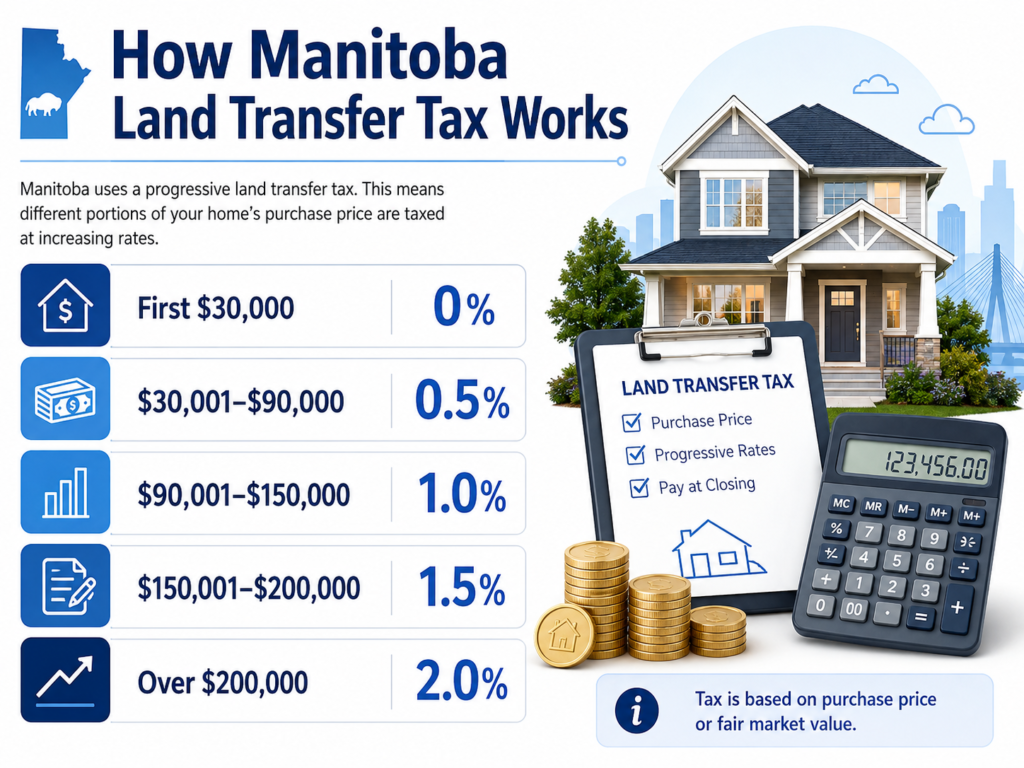
Manitoba currently uses the following progressive rates:
| Portion of property value | Tax rate |
|---|---|
| First $30,000 | 0% |
| $30,001 to $90,000 | 0.5% |
| $90,001 to $150,000 | 1.0% |
| $150,001 to $200,000 | 1.5% |
| Amount above $200,000 | 2.0% |
These brackets are published by Manitoba Finance. The tax is based on the fair market value of the property when the transfer is registered. (Government of Manitoba)
How Manitoba Land Transfer Tax Is Calculated
Manitoba uses a marginal or progressive calculation. This means that a property does not become subject to a single higher rate simply because its value enters the next bracket.
For example, when a property is worth more than $200,000:
The first $30,000 is taxed at 0%
The next $60,000 is taxed at 0.5%
The next $60,000 is taxed at 1%
The next $50,000 is taxed at 1.5%
Only the value above $200,000 is taxed at 2%
The tax accumulated through the first $200,000 is:
$300 + $600 + $750 = $1,650
Therefore, for an ordinary property value above $200,000, the calculation can be simplified as:
Land transfer tax =
$1,650 + 2% of the amount above $200,000
The Manitoba Land Transfer Tax Calculator performs this calculation automatically.
Manitoba Land Transfer Tax Examples
Example 1: Property worth $90,000
The first $30,000 is tax-free.
First $30,000 × 0% = $0
Next $60,000 × 0.5% = $300
Estimated land transfer tax: $300
Example 2: Property worth $150,000
First $30,000 × 0% = $0
Next $60,000 × 0.5% = $300
Next $60,000 × 1% = $600
Estimated land transfer tax: $900
Example 3: Property worth $200,000
First $30,000 × 0% = $0
Next $60,000 × 0.5% = $300
Next $60,000 × 1% = $600
Next $50,000 × 1.5% = $750
Estimated land transfer tax: $1,650
Example 4: Property worth $400,000
Tax on the first $200,000 = $1,650
Amount above $200,000 = $200,000
$200,000 × 2% = $4,000
Estimated land transfer tax: $5,650
Example 5: Property worth $500,000
First $30,000 at 0% = $0
Next $60,000 at 0.5% = $300
Next $60,000 at 1% = $600
Next $50,000 at 1.5% = $750
Remaining $300,000 at 2% = $6,000
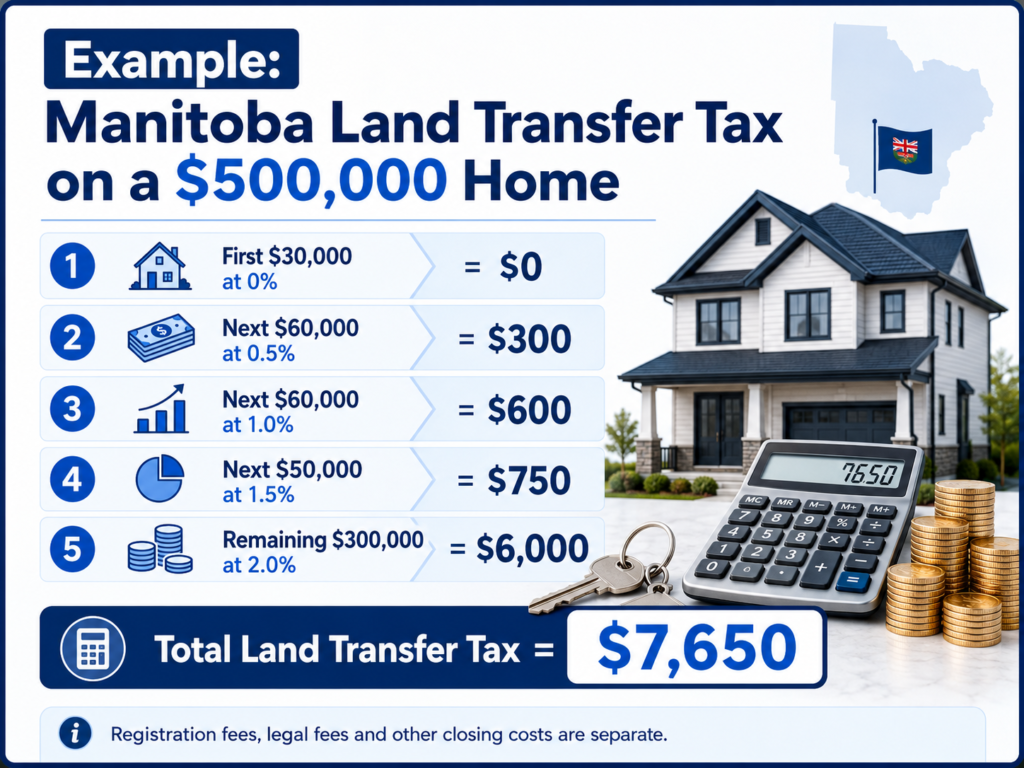
Estimated land transfer tax: $7,650
Example 6: Property worth $750,000
Tax on the first $200,000 = $1,650
Amount above $200,000 = $550,000
$550,000 × 2% = $11,000
Estimated land transfer tax: $12,650
You can test any property value using the Manitoba Land Transfer Tax Calculator at the top of this page.
Manitoba Land Transfer Tax Table
The following table provides quick estimates for several property values:
| Property value | Estimated land transfer tax |
|---|---|
| $30,000 | $0 |
| $50,000 | $100 |
| $90,000 | $300 |
| $100,000 | $400 |
| $150,000 | $900 |
| $175,000 | $1,275 |
| $200,000 | $1,650 |
| $250,000 | $2,650 |
| $300,000 | $3,650 |
| $400,000 | $5,650 |
| $500,000 | $7,650 |
| $600,000 | $9,650 |
| $750,000 | $12,650 |
| $1,000,000 | $17,650 |
These examples assume the standard Manitoba tax brackets and do not include registration charges or other closing expenses.
Is Land Transfer Tax Based on Purchase Price or Fair Market Value?
The official rule refers to the property’s fair market value on the date of registration, rather than relying exclusively on the amount written in the purchase agreement. (Government of Manitoba)
For many ordinary purchases between unrelated buyers and sellers, the purchase price may reasonably represent the property’s market value. However, additional considerations may arise when:
Property is transferred between relatives
Ownership is transferred as a gift
Only part of an ownership interest is transferred
The transaction involves a trust
The sale price does not represent market value
The transfer may qualify for an exemption
The calculator should be used as a planning tool. A Manitoba real-estate lawyer should determine the final taxable value and filing requirements.
Is There a First-Time Homebuyer Land Transfer Tax Rebate in Manitoba?
Manitoba’s standard published land transfer tax schedule does not currently list a broad provincial rebate that automatically eliminates the tax for every first-time homebuyer.
First-time buyers should therefore include the estimated tax in their initial home-buying budget unless a lawyer confirms that a specific exemption applies to their transaction.
Do not confuse Manitoba land transfer tax with federal homebuyer programs or income-tax credits. These programs may reduce other home-buying costs but do not automatically remove Manitoba’s provincial transfer tax.
Is the Land Titles Registration Fee Included?
No. The Manitoba Land Transfer Tax Calculator estimates land transfer tax only.
Manitoba explains that a transferee may be required to pay both land transfer tax and a registration fee when the transfer is registered. (Government of Manitoba)
Depending on the transaction, additional registrations may also be required, such as registering a mortgage.
Registration charges can change. Confirm the current fee with:
Your real-estate lawyer
Teranet Manitoba
The applicable Manitoba Land Titles Office
Other Closing Costs to Consider
Land transfer tax is only one part of a complete home-buying budget.
Buyers may also need money for:
Down payment
Mortgage loan insurance
Transfer registration
Mortgage registration
Lawyer’s professional fees
Legal disbursements
Title insurance
Home inspection
Property appraisal
Property-tax adjustment
Utility adjustments
Home insurance
Moving costs
Immediate repairs or renovations
Use the Manitoba Mortgage Calculator to compare mortgage payments, down-payment amounts and financing scenarios.
The mortgage calculator also explains how land transfer tax fits into a broader Manitoba home-buying budget. (omnitools.ca)
When Is Manitoba Land Transfer Tax Paid?
The tax is generally dealt with when the property transfer is registered through Manitoba’s Land Titles system.
In a typical home purchase, the buyer’s lawyer calculates the amount, collects the required funds and handles the registration process as part of closing.
Ask your lawyer for a written statement showing:
Purchase funds
Land transfer tax
Registration charges
Legal fees
Disbursements
Tax adjustments
Other closing amounts
The amount produced by an online calculator should not replace your lawyer’s final closing statement.
Can Manitoba Land Transfer Tax Be Added to a Mortgage?
Land transfer tax is generally considered a closing cost rather than part of the property’s purchase price.
Whether a buyer can indirectly borrow funds to cover it depends on the lender, mortgage qualification, available credit and financing structure. Buyers should not assume that the tax will automatically be added to their mortgage balance.
Before making an offer, calculate:
Down payment
+ Land transfer tax
+ Registration expenses
+ Legal and inspection costs
+ Other closing expenses
This provides a more realistic estimate of the cash needed to complete the purchase.
Why Use the Manitoba Land Transfer Tax Calculator?
The Manitoba Land Transfer Tax Calculator can help you:
Estimate a major closing cost
Compare properties at different prices
Plan the cash required at closing
Understand Manitoba’s progressive rates
Review each part of the calculation
Avoid applying 2% to the entire property value incorrectly
Because the calculation is progressive, calculating it manually can lead to errors. The calculator separates the value into the appropriate brackets automatically.
Frequently Asked Questions
Is the Manitoba Land Transfer Tax Calculator free?
Yes. The calculator is free to use and does not require registration.
Does the calculator include legal fees?
No. It estimates provincial land transfer tax only. Legal fees, disbursements, registration fees, title insurance and other costs are separate.
What is the tax on a $300,000 home in Manitoba?
The estimated land transfer tax is $3,650.
Tax on first $200,000 = $1,650
Remaining $100,000 × 2% = $2,000
Total = $3,650
What is the tax on a $400,000 home?
The estimated tax is $5,650.
What is the tax on a $500,000 home?
The estimated tax is $7,650.
What is the tax on a $750,000 home?
The estimated tax is $12,650.
Is the full property value taxed at 2%?
No. The 2% rate applies only to the portion of the property value above $200,000.
Is land transfer tax the same as annual property tax?
No. Land transfer tax is associated with transferring ownership. Municipal property taxes are recurring charges based on municipal assessment and local tax rates.
Can the final amount differ from the calculator?
Yes. The final amount can differ because the legally relevant fair market value, exemptions, ownership interest, registration details or nature of the transaction may require additional analysis.
Who confirms the final tax?
A Manitoba real-estate lawyer or the appropriate Land Titles authority should confirm the final amount and filing requirements.
Final Thoughts
The Manitoba Land Transfer Tax Calculator provides a simple way to estimate one of the most important closing expenses when buying property in Manitoba.
Enter the property’s purchase price or fair market value, review the progressive calculation and include the result in your home-buying budget. Remember that the estimate does not include registration fees, legal services, title insurance, inspections or other closing expenses.
For a more complete estimate, use the Manitoba Mortgage Calculator to calculate your mortgage payment, minimum down payment and potential mortgage insurance.
Confirm all final amounts with your lender and Manitoba real-estate lawyer before completing a purchase.
Last reviewed: August 2026
Disclaimer: This calculator and article are provided for general educational purposes only. They do not constitute legal, tax, mortgage or financial advice. OmniTools is not affiliated with the Province of Manitoba, Teranet Manitoba or any Land Titles Office. Tax rules, registration charges and transaction requirements may change.
External sources
The official Manitoba source confirms the fair-market-value basis, progressive brackets and separate registration-fee requirement. (Government of Manitoba)